
Understanding the Rights of an Employee in India: Legal Protections and Workplace Entitlements
Employment in India is regulated by an extensive framework designed to safeguard workers against exploitation and ensure fair treatment at the workplace. From wages and leave entitlements to termination procedures and social security, the rights of an employee in India are protected under multiple statutes.
This article explains the legal foundation of employee rights in India, highlights the major labour laws in India, and outlines what employees and employers should know to maintain compliance and workplace fairness.
1. Legal Framework Governing Employee Rights
The rights of an employee in India stem from several central and state statutes. The most significant among these include:
- Industrial Disputes Act, 1947 –governs layoffs, retrenchments, and dispute resolution.
- Factories Act, 1948 –regulates health, safety, and working conditions in industrial establishments.
- Shops and Establishments Acts (State-specific) –govern working hours, leave, and termination for non-factory employees.
- Payment of Wages Act, 1936 –ensures timely and lawful payment of wages.
- Minimum Wages Act, 1948 –sets wage floors for different employment categories.
- Employees’ Provident Funds and Miscellaneous Provisions Act, 1952 –mandates retirement benefits and employer contributions.
- Payment of Gratuity Act, 1972 –provides gratuity to employees with continuous service of five years or more.
Together, these statutes form the foundation of employment law in India and ensure workers’ welfare in both organized and unorganized sectors.
2. Fundamental Rights of Employees in India
The employee rights India guarantees include both statutory and constitutional protections. The key workplace rights India recognises are:
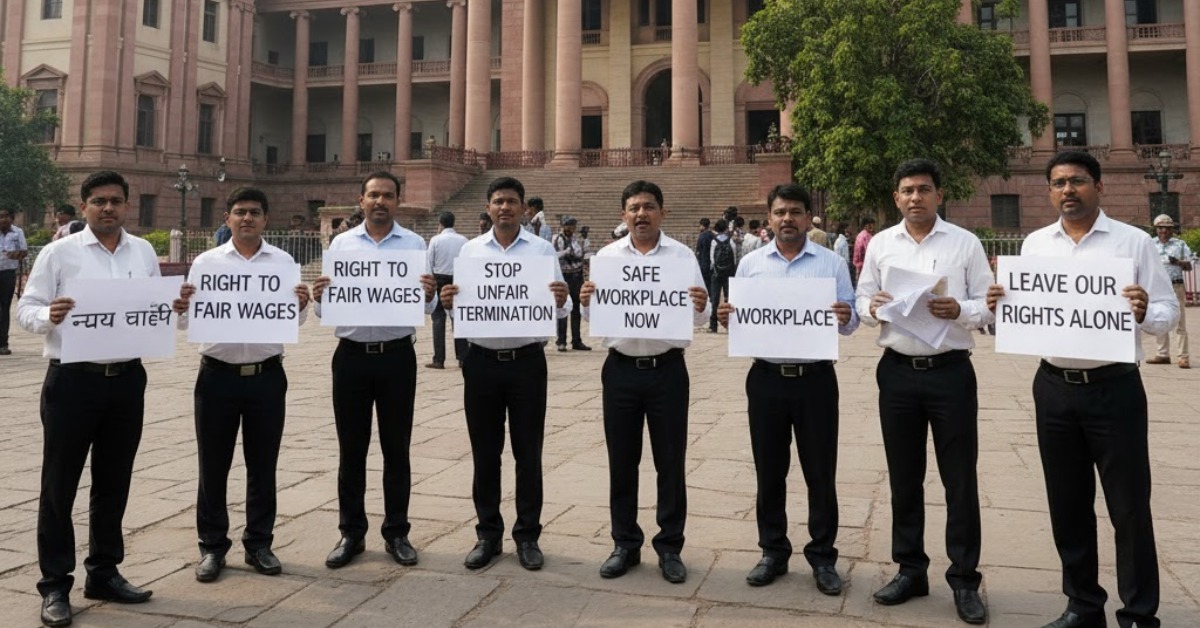
- Right to Fair Wages: Employers must pay at least the prescribed minimum wage law India mandates, ensuring no underpayment.
- Right to Safe Working Conditions: Every employer must provide hygienic, safe, and risk-free work environments..
- Right to Fixed Working Hours and Paid Leave: Standard working hours (usually 8 hours a day) and weekly rest are mandatory. Annual, casual, and sick leave entitlements are defined under respective state laws.
- Right Against Unfair Termination: Termination must follow due process under termination laws India, with notice and compensation where applicable.
- Right to Social Security Benefits: Provident fund, gratuity, employee insurance, and maternity benefits are integral to employee benefits India.
- Right to Equal Opportunity: Discrimination based on gender, caste, religion, or disability is prohibited under constitutional and statutory norms.
These core entitlements represent the minimum standards that every employer must uphold.
3. Wages, Hours, and Leave Rules
Working hours and leave rules are regulated primarily by the Factories Act and the Shops and Establishments Acts. Key standards include:
- Working Hours: Normally capped at 48 hours per week with one mandatory day off.
- Overtime Pay: Employees working beyond prescribed hours are entitled to twice their ordinary wage rate.
- Leave Entitlements:
1. Earned/Annual Leave: Minimum of 12 to 15 days annually.
2. Sick Leave: Typically 10–12 days a year.
3. Casual Leave: Around 7 days a year depending on state law.
- Public Holidays: Employees are entitled to national and festival holidays as notified
These rules preserve the balance between productivity and employee well-being.
4. Termination Laws in India
The termination laws India enforces require procedural fairness. Employers cannot dismiss workers arbitrarily.
Key aspects include:
- Notice Period: Usually one month’s notice or pay in lieu is required.
- Retrenchment Compensation: For employees completing at least one year of service, 15 days’ average pay for every completed year is payable.
- Grounds for Dismissal: Misconduct, redundancy, or continued ill-health may justify termination but must follow inquiry and documentation.
- Unlawful Termination: Workers wrongfully dismissed may approach labour courts or industrial tribunals for reinstatement or compensation.
Compliance with employment law India ensures that termination decisions are legally defensible and ethically sound.
5. Social Security Benefits in India
Under the social security benefits India framework, several welfare schemes protect employees and their dependents:
- Employees’ Provident Fund (EPF):Employer and employee each contribute 12 percent of basic pay.
- Employees’ State Insurance (ESI): Provides medical, maternity, and disability benefits.
- Maternity Benefit Act, 1961: Entitles female employees to 26 weeks of paid maternity leave.
- Payment of Gratuity Act, 1972: Offers a lump-sum payment after five years of continuous service.
- Employee Pension Scheme (EPS): Provides post-retirement financial security.
These schemes strengthen the rights of an employee in India by ensuring long-term protection beyond employment tenure.
6. Employee Grievance Redressal Mechanism
Every organisation should maintain a transparent employee grievance redressal system. Employees can raise issues concerning wages, discrimination, working conditions, or unfair termination through:
- Internal Committees: For routine workplace grievances.
- Labour Commissioners or Inspectors: For unresolved matters under relevant labour laws in India.
- Labour Courts and Industrial Tribunals: For industrial disputes and wrongful termination cases.
- Internal Complaints Committee (ICC): Mandated under the POSH Act, 2013 to address sexual harassment complaints.
7. Protection Against Workplace Harassment
The Prevention of Sexual Harassment (POSH) Act, 2013 is a cornerstone of workplace rights India. It obligates every employer to:
- Constitute an Internal Complaints Committee at each office location.
- Conduct awareness and sensitization programs.
- Investigate complaints confidentially and impartially.
- Impose penalties or recommend disciplinary action against offenders.
This statute reinforces dignity, equality, and safety for all employees, especially women, in the workplace.
8. Employee Rights in the Digital Age
Remote work and digital employment have expanded the scope of labour laws in India. Key emerging areas include:
- Data Privacy and Confidentiality: Employees’ personal and professional data are protected under IT and privacy frameworks
- Right to Disconnect: Discussions are ongoing around limits on after-hours digital communication.
- Gig and Platform Workers: The Code on Social Security, 2020 recognises gig workers and provides welfare provisions.
These reforms adapt employment law India to evolving workplace models.
9. Enforcement and Dispute Resolution
Disputes concerning the rights of an employee in India can be resolved through:
- Conciliation Officers under the Industrial Disputes Act.
- Labour Courts and Tribunals for adjudication.
- High Courts for writ petitions in exceptional cases.
- Grievance redressal committees within private establishments.
Effective enforcement mechanisms ensure that employee rights India are upheld across all employment sectors.
Conclusion
The rights of an employee in India represent the cornerstone of workplace justice. Backed by comprehensive labour laws in India, these rights guarantee fair wages, safe conditions, security benefits, and protection from arbitrary termination.
For employees, awareness is the first line of defense; for employers, compliance is both a legal and ethical obligation. As India modernises its employment law framework, the balance between productivity and protection will continue to evolve; ensuring that every worker enjoys dignity, fairness, and respect in the workplace.