Understanding Labour Codes in India: What Every Employer and Worker Should Know
India’s labour market includes millions of workers who operate across manufacturing, services, gig platforms, contractual roles and informal segments. Managing such a diverse workforce under dozens of older labour laws became increasingly difficult for both employers and workers. To resolve fragmentation and strengthen worker welfare, the government consolidated 29 central labour laws into four comprehensive labour codes India now recognises as the core of the country’s employment law framework.
Understanding Labour Codes in India is essential for organisations navigating reforms relating to wages, social security benefits, workplace safety and industrial relations. These codes affect employer obligations labour, worker rights India, fixed term employees India, compliance norms and dispute resolution. The new structure aims to simplify regulations, reduce overlap, and promote a transparent and predictable labour environment.
This blog explains the purpose and structure of the four labour codes India has introduced, key rights for workers, obligations for employers, opportunities and challenges under the new regime, and practical steps stakeholders should take to adjust to the transition.
1. The Four Labour Codes: Structure and Intent
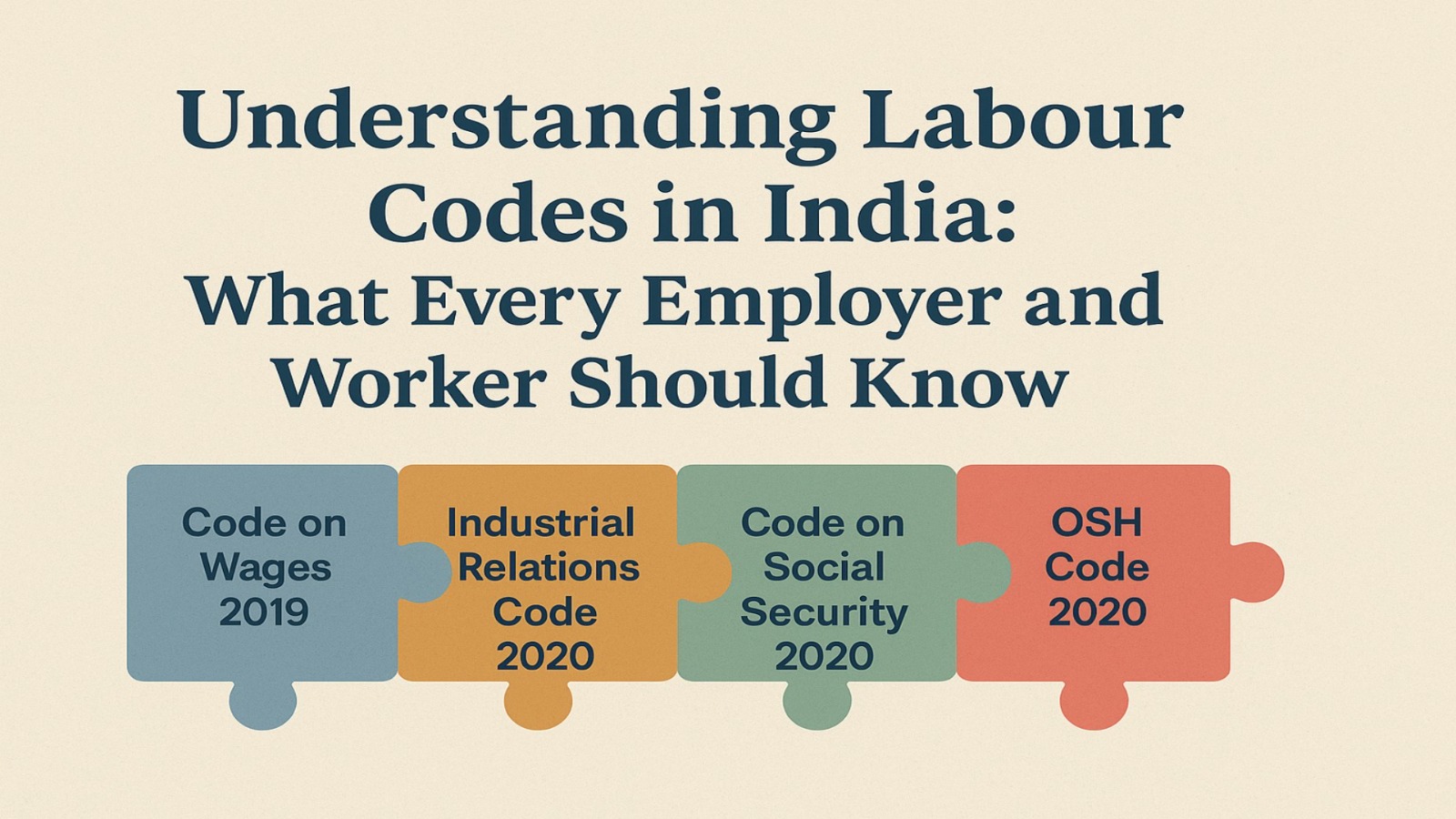
To streamline labour regulation and modernise outdated processes, the government introduced four major codes. Understanding Labour Codes in India begins with understanding what each code covers and why it matters.
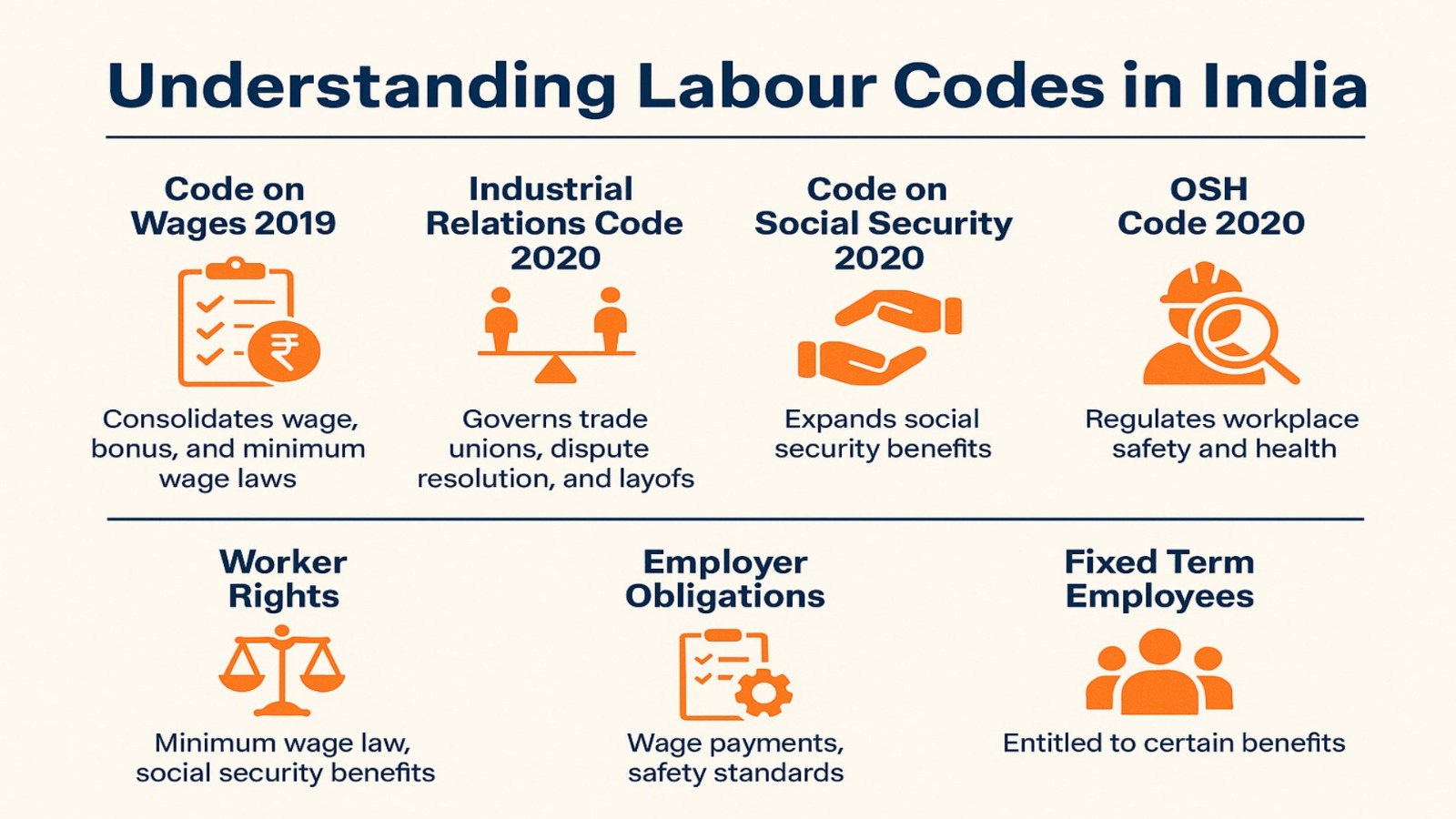
The Code on Wages 2019 consolidates the laws relating to wages, bonus, equal remuneration and minimum wage law. It creates a uniform definition of wages for all sectors, reduces ambiguity in wage calculations and ensures that every worker receives statutory minimum wages regardless of employment category.
The Industrial Relations Code 2020 replaces multiple laws relating to trade unions, standing orders and industrial disputes. It aims to promote dispute resolution, encourage formal documentation of employment conditions and establish clearer rules for layoffs, retrenchment and strikes. The code also updates thresholds for standing orders and dispute procedures to align with modern industry requirements.
The Code on Social Security 2020 expands social security benefits to a wider pool of workers. It integrates laws governing provident fund schemes, employees’ state insurance, maternity benefits, gratuity and welfare funds. The most notable change is the inclusion of gig workers, platform workers and fixed term employees India under certain social security categories, extending long overdue protections to flexible workforce groups.
The Occupational Safety, Health and Working Conditions Code 2020 (OSH Code) consolidates laws aimed at regulating workplace safety, health standards, working hours and welfare provisions. It focuses on improving the overall working environment in factories, mines, plantations, warehouses and service establishments. It introduces standard safety obligations and requires employers to meet specific working condition norms.
The combined intention behind Labour codes India is clear. They aim to reduce compliance complexity by merging similar laws, promote formalisation of labour arrangements, improve protections for vulnerable workers and align India’s labour regulation with modern economic structures.
2. Key Rights and Protections for Workers
A major objective of the reforms is to expand and reinforce worker rights India across sectors. Under the unified labour codes India approach, several important protections apply to employees, contract labourers, and other categories of workers.
A core feature is the universalisation of minimum wage law. The Code on Wages 2019 ensures that every worker, regardless of skill level or industry, receives wages not below the statutory minimum. This eliminates earlier disparities where minimum wage protections applied only to schedules of employments.
The codes strengthen social security benefits by expanding coverage to informal and platform workers. Under the Code on Social Security 2020, a broader range of workers can receive benefits relating to provident fund, insurance, maternity leave and gratuity. This is significant because millions of Indian workers traditionally operated outside formal safety nets.
Workplace safety and welfare standards have also been enhanced. The OSH Code 2020 requires employers to ensure proper ventilation, sanitation, drinking water, restrooms, first aid and annual health checkups in certain establishments. This promotes safer working environments and aligns with global occupational safety norms.
A key advancement is formalisation. Employers must provide written appointment letters at the time of hiring. This encourages clarity regarding job roles, wages, working hours, leave policies and worker rights India. A written contract reduces disputes and establishes a clear record of terms agreed between employers and employees.
Another important reform is the extension of gratuity and certain benefits to fixed term employees India. Earlier, only permanent employees with continuous service were eligible for long term benefits such as gratuity. Under the new codes, fixed term workers who complete the prescribed period become entitled to proportional gratuity, promoting fairness across workforce categories.
Taken together, these reforms strengthen the position of workers, enhance protections, and promote uniformity across diverse forms of employment.
3. Employer Obligations and Compliance Under the New Codes
The simplified structure under Labour codes India does not reduce employer responsibilities. Instead, it consolidates them into a clearer and more structured framework. Understanding Labour Codes in India requires awareness of these duties.
Employers must comply with wage payments in accordance with the Code on Wages 2019. This includes paying wages within prescribed timelines, adhering to minimum wage law and avoiding unauthorized deductions. Employers must classify allowances, bonuses and incentives consistently with the uniform definition of wages.
The new system requires maintaining detailed records and registers. Employers must keep track of attendance, overtime, wage payments, social security contributions and compliance filings. Proper documentation is essential for inspections and dispute resolution.
The OSH Code introduces obligations relating to safety, welfare and working conditions. Employers must provide protective equipment where necessary, ensure safe premises, and follow prescribed working hour limits, especially for hazardous occupations. They must also conduct periodic health checkups for workers in designated roles.
Under the Code on Social Security 2020, employers have obligations to contribute to provident fund, employees’ insurance and other schemes, depending on the size and category of the workforce. This applies even when workers engage through contractors. Principal employers may be held responsible for non-compliance of contractors in certain situations.
The Industrial Relations Code requires employers to adhere to rules on layoffs, retrenchment, closure and dispute resolution. Establishments above certain thresholds must prepare standing orders covering working hours, leave, conduct, and other service conditions.
Overall, employer obligations labour under the new codes emphasise transparency, documentation and proactive compliance. Businesses must update HR policies, employment contracts and internal processes to align with the unified framework.
4. Key Opportunities and Challenges Under the New Regime
Understanding Labour Codes in India also involves examining the opportunities created by consolidation and the challenges that may arise during implementation.
The streamlined structure offers several advantages. Consolidation of laws reduces complexity for employers who previously had to comply with numerous overlapping statutes. With unified definitions, digital filing systems and simplified registration processes, compliance becomes more predictable.
Another advantage is greater social security benefits for workers. Expanded coverage can improve financial security, healthcare access and overall workplace well being. Including fixed term employees India and gig workers under selected schemes reflects modern workforce realities.
Uniform wage definitions reduce disputes relating to wage calculation and bonus eligibility. Standardised terms help organisations align wage structures and reduce compliance inconsistencies.
However, challenges also exist. Some businesses may face higher wage bills due to reclassification of allowances under the uniform wage definition. Small enterprises may find the expanded compliance requirements challenging due to limited administrative capacity.
There are concerns regarding effective enforcement. While the codes aim to encourage self-certification and digital inspection, the transition from traditional inspection systems to updated frameworks may result in compliance gaps.
Another concern relates to industrial relations. Trade unions and worker groups have raised queries regarding layoff thresholds, fixed term employment norms and changes to dispute resolution procedures. Employers must navigate these issues carefully to avoid conflict.
The shift to the new codes will require phased implementation, updated rules by states and significant capacity building across industries. Stakeholders must stay updated to avoid compliance issues during the transition period.
5. What Workers, Employers and Legal Practitioners Should Do Next
Adapting to the new labour codes India requires proactive steps by all stakeholders. Understanding Labour Codes in India is not enough unless actions are taken to align with the updated framework.
Workers should ensure they receive formal appointment letters reflecting their role, wages and benefits. They should track social security deductions, understand entitlements under the new codes and raise concerns regarding unsafe working conditions or unfair practices.
Employers must review existing HR practices, employment contracts, payroll structures and compliance documentation. Wage structures may need reworking to align with the new wage definition. Safety and welfare measures must be re-evaluated to meet OSH Code requirements. Consultation with HR and legal professionals is advisable during this transition.
Employers engaging fixed term employees India and gig workers must revisit policies to ensure that benefits align with the Social Security Code requirements. Clear communication with workers and transparent documentation will help avoid disputes.
Legal practitioners must assist clients in updating policies, drafting compliant employment agreements, conducting compliance audits, and managing industrial relations issues under the new codes. They should also monitor evolving rules and state notifications that supplement the codes.
Taking these steps ensures that all stakeholders make a smooth transition to the new labour regime while safeguarding rights and reducing the risk of non-compliance.
Conclusion
The introduction of Labour codes India marks a significant milestone in India’s labour law framework. By consolidating 29 laws into four comprehensive codes, the government aims to create a modern, efficient and fair system for workers and employers. Understanding Labour Codes in India helps stakeholders appreciate the scope of the reform, the protections available to workers and the obligations placed on employers.
As the labour ecosystem evolves, awareness, compliance and proactive adjustment will determine how effectively stakeholders can navigate this transformation. With the right approach, the new labour codes can create a balanced and transparent environment that supports economic growth and worker welfare.