Understanding Intellectual Property Disputes in India: A Complete Legal Guide
Intellectual property plays an increasingly critical role in India’s digital and commercial economy. Creative works, software, brand names, designs, inventions and confidential information form the backbone of modern business operations. When these creations are misused, copied or infringed, parties face serious financial losses and reputational harm. Understanding intellectual property disputes in India is essential for businesses, creators, startups, influencers and technology companies who rely on innovation and brand goodwill.
IP disputes India cover a wide range of conflicts including trademark disputes India, copyright disputes India, patent disputes India and design infringement India. These disputes arise when someone uses protected intellectual property without permission, causing damage or dilution to the original owner’s rights. Intellectual property rights enforcement involves civil remedies, interim injunctions, damages, customs seizures, criminal action in some cases and the broader framework of IP litigation India.
This blog explains how intellectual property disputes arise, the nature of different IP categories, the dispute and enforcement process, remedies available and practical steps organisations should take to protect their IP portfolio.
1. What Are Intellectual Property Disputes and Why Do They Matter
Understanding intellectual property disputes in India begins with recognising why IP protection exists. Intellectual property rights protect creations of the mind. These rights allow owners to control how their inventions, brands, artistic works and designs are used. When another party uses those works without permission, it results in an IP dispute.
IP disputes India arise in several situations. Businesses often face disputes when competitors copy their brand name, logo or packaging, leading to trademark disputes India. Software developers and artists often deal with copyright disputes India relating to unauthorised reproduction of content, software code or media. Companies in research and technology sectors may face patent disputes India involving inventions, processes or technology. Manufacturers may face design infringement India when product designs are replicated or imitated.
Such disputes are serious because intellectual property often forms a significant portion of a company’s value. Misuse of a trademark can mislead customers, weaken goodwill and cause loss of revenue. Unauthorized copying of content or software can deprive creators of rightful income. Inventions and designs may lose exclusivity if not protected promptly.
Understanding intellectual property disputes in India allows businesses to protect innovation and take swift action when misuse occurs.
IP rights exist to preserve originality, encourage creativity and promote fair competition. When disputes arise, the legal system provides structured mechanisms for intellectual property rights enforcement.
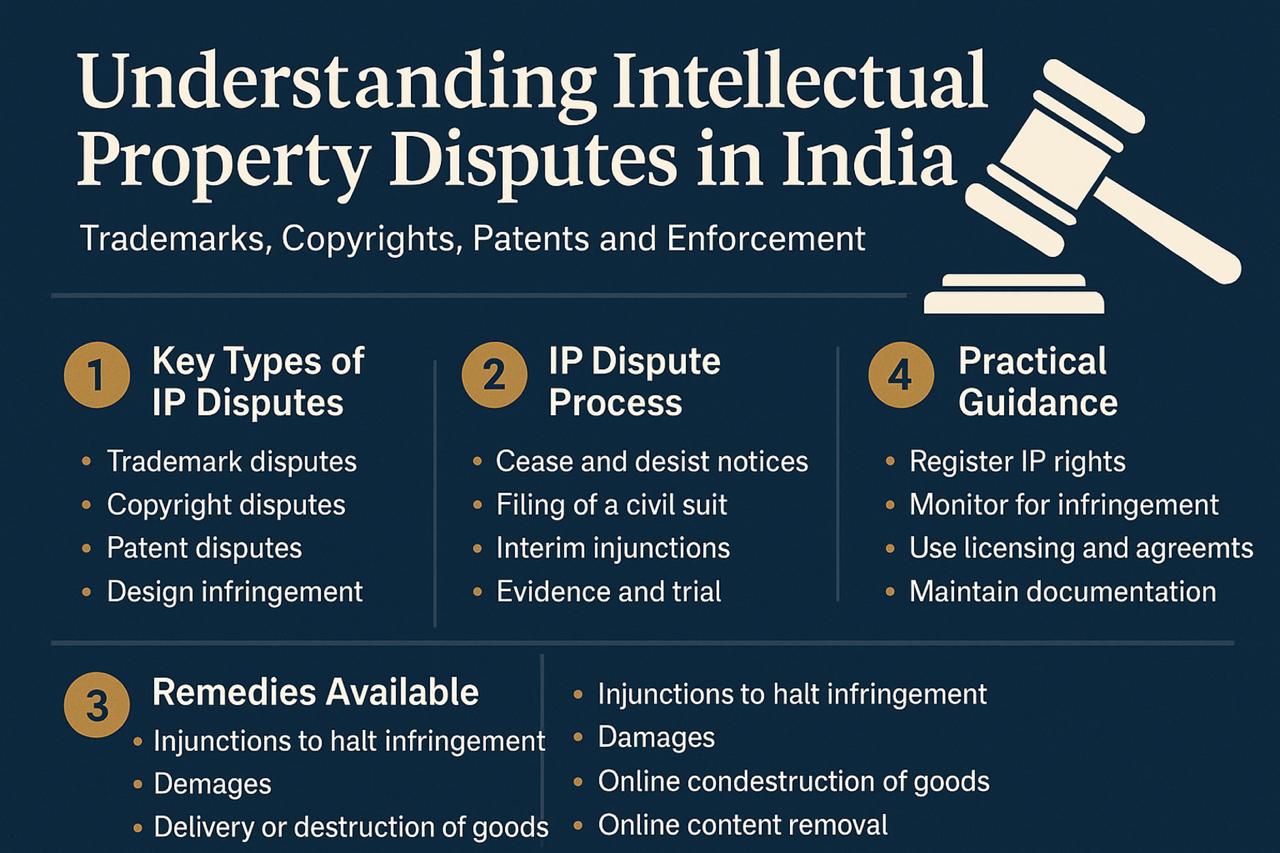
2. Key Types of Intellectual Property Disputes in India
There are several types of IP disputes India recognises, each with its own nature and enforcement methods. Understanding these categories helps individuals and companies assess the correct legal remedy.
- The most common category is trademark disputes India. These involve conflicts relating to brand names, logos, domain names, taglines or trade dress. Trademark disputes often arise when another business uses a confusingly similar mark, misleads consumers or capitalises on existing goodwill. Passing off disputes occur when trademarks are unregistered but still protected through reputation.
- Another major category is copyright disputes India, which relate to creative works such as songs, films, books, software code, photographs, web content and artistic designs. Copyright infringement occurs when someone reproduces, distributes or publicly uses copyrighted content without consent. Digital advancements have increased online piracy, software copying and misuse of creative content.
- Patent disputes India involve inventions, processes, machines and technical innovations. Patent infringement occurs when a party manufactures, uses or sells a patented invention without permission. These disputes are complex due to technical expertise, licensing arrangements and freedom to operate evaluations.
- Businesses also face design infringement India, which involves copying of shape, configuration, pattern or ornamentation applied to products. Industries such as consumer goods, fashion, automotive accessories and home appliances commonly encounter design disputes.
- Other forms of IP disputes include misuse of confidential information, trade secret theft, counterfeit goods, comparative advertising disputes and illegal domain name registrations.
Understanding types of intellectual property disputes in India helps parties choose appropriate forums, remedies and strategies for IP litigation India.
3. How the IP Dispute and Enforcement Process Works in India
Understanding intellectual property disputes in India requires clarity on how enforcement works. IP litigation India typically begins when the owner identifies unauthorized use or duplication of protected IP.
The first step is often issuing cease and desist notices India. This notice informs the infringer about the IP owner’s rights and demands immediate cessation of use. Many disputes settle at this stage if the infringer agrees to stop the violation or negotiate licensing terms.
If the dispute continues, the next step is filing a civil suit before the appropriate court. IP disputes India are usually handled by district courts with commercial jurisdiction or High Courts depending on valuation and location. The court may grant urgent interim injunctions to restrain the infringing activity even before the full trial. Interim injunctions are important because delay in IP enforcement may cause irreversible harm.
During the proceedings, parties submit documents, evidence, images, product samples, technical reports, expert opinions and proof of registration. The court evaluates the likelihood of infringement, confusion among consumers, similarity between products or marks and the impact on reputation.
In copyright disputes India and software related matters, digital evidence, metadata and usage logs play a major role. In patent disputes India, technical specifications, prior art and expert evidence are crucial.
IP disputes India may also involve border enforcement. Customs authorities can seize counterfeit or infringing goods at ports if the IP owner registers their rights with customs.
Some cases may involve criminal complaints for counterfeiting, piracy or trademark falsification depending on the nature and seriousness of the violation. However, most enforcement happens through civil remedies.
Understanding the IP infringement process India helps businesses respond effectively when their rights are violated.
4. Remedies Available in Intellectual Property Disputes
The legal system provides several remedies for resolving intellectual property disputes in India. Remedies depend on the type of infringement and the harm suffered.
- The most important remedy is injunction, which prevents the infringer from continuing the infringing activity. Courts may grant temporary or permanent injunctions depending on urgency and strength of evidence. Injunctions protect brand reputation, prevent further sales of infringing goods and safeguard consumer interests. This is essential in trademark disputes India and design infringement India.
- Courts may also award damages for financial losses suffered due to infringement. Damages may include actual loss, loss of profits or statutory damages depending on the nature of the IP right. In some cases, the court may award account of profits, which requires the infringer to hand over profits earned through the violation.
- Delivery and destruction of infringing goods is another important remedy, especially in counterfeit product disputes. Courts may order seizure of goods, packaging, labels and promotional material.
- In copyright disputes India, courts may order removal of infringing content from online platforms, blocking of websites or deletion of illegal copies.
- In patent disputes India, courts may issue orders to restrain manufacturing, import or sale of infringing products and may grant monetary compensation.
- IP owners may also seek declaratory reliefs confirming their ownership and exclusive rights. In some cases, criminal penalties may apply to counterfeiting, piracy or fraudulent use of trademarks.
Understanding civil remedies in IP litigation India helps rights holders protect their creations, maintain exclusivity and deter future infringement.
5. Practical Guidance for Businesses, Creators and Startups
Understanding intellectual property disputes in India is not only about knowing the laws. Effective prevention, documentation and proactive strategy are essential for protecting innovation and creative output.
Businesses should register trademarks, copyrights, patents and designs promptly. Registration strengthens rights, speeds up enforcement and improves the chances of obtaining injunctions. Startups should prioritise brand protection India at early stages to avoid conflicts with existing brands.
Companies should monitor markets, online platforms, social media and e commerce websites for potential infringement. Early detection allows quick action through cease and desist notices India.
Organisations dealing with technology or creative content should use confidentiality agreements, licensing documents and internal IP policies. Protecting trade secrets through secure digital systems reduces risk of leakage.
Businesses should maintain records of creation, development, marketing and sales to support IP ownership in case of disputes. For technology companies, maintaining source code logs, development timelines and architecture documentation is essential.
When disputes arise, parties should assess whether negotiations or settlements are preferable to litigation. Many IP disputes India settle through licensing arrangements, coexistence agreements or rebranding strategies.
Creators, designers and influencers should track usage of their content and take timely action in case of unauthorised copying. They should also understand copyright exceptions and fair use limitations that apply in specific circumstances.
By maintaining clear documentation, registering IP promptly and responding swiftly to infringement, businesses and creators can safeguard their rights and reduce the risk of prolonged legal battles.
Conclusion
Understanding intellectual property disputes in India is critical for businesses, creators and innovators operating in a competitive and rapidly changing market. IP disputes arise when trademarks, copyrights, patents or designs are misused, copied or reproduced without permission. The dispute resolution process involves notices, injunctions, civil suits, evidence evaluation and enforcement actions.
By safeguarding IP assets through registration, monitoring, documentation and legal preparedness, individuals and businesses can protect their innovation and maintain competitive advantage. Intellectual property remains a valuable asset, and effective IP enforcement plays a central role in securing commercial success and preserving creative integrity.