Understanding Criminal Disputes in India: A Complete Guide for Individuals and Businesses
Criminal law plays a central role in maintaining order, safety and accountability in society. Any act that causes harm, threatens public safety or violates statutory prohibitions is dealt with under the criminal justice system. Understanding criminal disputes in India is essential for individuals, professionals and businesses because criminal allegations carry serious consequences such as arrest, imprisonment, reputational harm and financial loss.
Criminal dispute resolution India involves a structured sequence that begins with the registration of a complaint or FIR, followed by investigation, bail hearings, filing of charges, trial and final judgment. The criminal case process India is governed by the Bharatiya Nyaya Sanhita, the Bharatiya Nagarik Suraksha Sanhita and other procedural rules. The system is designed to balance the rights of the complainant, societal interests and the criminal rights of accused persons.
This blog explains the nature of criminal disputes, classification of offences, FIR procedure India, roles of police and courts, the bail process India and the stages of a criminal trial. It also highlights practical considerations for individuals or businesses facing criminal allegations.
1. What Constitutes a Criminal Dispute in India
Understanding criminal disputes in India starts with recognising what makes conduct criminal. A criminal dispute arises when a person is accused of committing an act that is prohibited by law and punishable by the state. Criminal offences involve wrongdoing against society at large, even though the immediate victim may be an individual or organisation.
Criminal wrongs include actions such as assault, theft, fraud, misappropriation, cheating, breach of trust, intimidation, harassment, cyber offences, defamation and financial crimes. With the rise of digital commerce and financial transactions, businesses often face criminal allegations such as cheating, data theft, cyber fraud or breach of trust.
Criminal disputes differ from civil disputes because the objective is not compensation but punishment for the offender and protection of society. Criminal dispute resolution India is led by police authorities and public prosecutors, not by private parties alone. The burden of proof is also significantly higher, requiring guilt to be proved beyond reasonable doubt.
In many situations, criminal allegations arise due to commercial disagreements, partner conflicts or financial defaults that escalate into accusations of cheating or fraud. Because of this, understanding the distinction between breach of contract and criminal breach of trust becomes extremely important.
Criminal law widely affects individuals and organizations, making it essential to understand the processes and obligations involved.
2. Classification of Criminal Offences in India
India classifies criminal cases into several categories that shape how the criminal case process India unfolds.
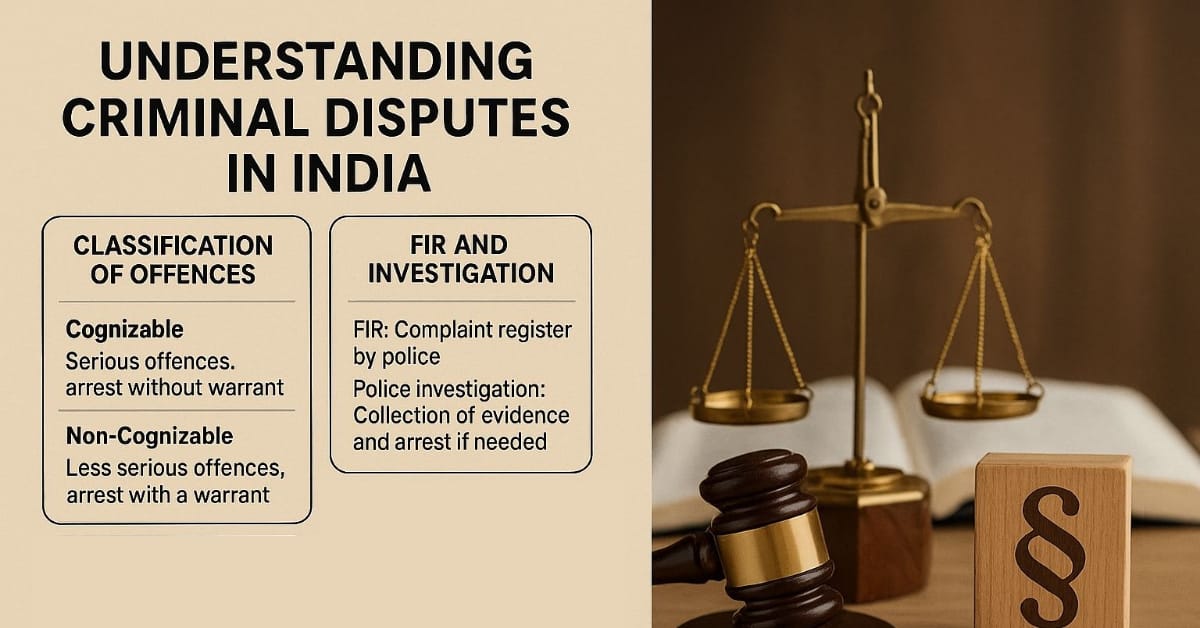
- One major distinction is between cognizable offences India and non cognizable offences India. Cognizable offences involve serious wrongdoing, where police can register an FIR and arrest the accused without a warrant. Examples include murder, rape, theft, kidnapping, fraud exceeding prescribed value and criminal breach of trust.
- Non cognizable offences require a court order before police can investigate or arrest. These include minor assault, simple harassment, defamation or small financial disputes. Understanding the nature of the offence helps determine whether police action begins immediately or only after a court direction.
- Criminal offences are also classified as bailable or non bailable. In bailable offences, the accused has the right to bail. In non bailable offences, the bail process India requires detailed hearings and judicial discretion. Serious offences such as major fraud, violent crimes or aggravated harm usually fall within non bailable categories.
- Economic offences, cyber crimes and corporate misconduct fall under special provisions and may involve financial agencies or specialised investigation units. Businesses often face criminal allegations relating to forgery, fraud, cheating, data breaches or statutory non compliance.
Understanding these categories is essential because they influence FIR procedure India, the police investigation process, arrest rules and the availability of reliefs at different stages.
3. FIR, Investigation and Early Stages of a Criminal Case
Understanding criminal disputes in India requires clarity on how a criminal case begins. Most criminal matters start with lodging a complaint with the police. If the complaint discloses information about a cognizable offence, police must register an FIR. FIR procedure India requires the police to record the complaint, provide a copy to the complainant and initiate investigation promptly.
In non cognizable offences India, the police may record the complaint in the station diary but cannot investigate without court permission. The complainant may need to approach the magistrate through a private complaint for further action.
Once the FIR is registered, the police investigation process begins. This may involve collecting evidence, recording witness statements, issuing notices, examining digital records, making site visits and seizing documents. In serious cases, police may arrest the accused if necessary to prevent interference with evidence or to maintain public safety.
During this period, the accused has important criminal rights of accused persons, including the right to legal representation, the right against self incrimination and the right to apply for bail.
At the end of the investigation, police submit a report to the magistrate. If evidence supports the allegations, a chargesheet is filed. If not, a closure report may be filed. The complainant can contest a closure report through protest petitions.
The early stages of a criminal case require strategy, documentation and legal support because missteps at this stage may shape the outcome of the entire criminal dispute resolution India process.
4. Bail, Trial and Remedies in Criminal Cases
The next major stage after investigation involves hearings related to bail. The bail process India differs for bailable and non bailable offences. In bailable offences, bail is a right. For non bailable offences, the accused must apply to the magistrate or sessions court and demonstrate reasons such as cooperation with investigation, lack of criminal intent or low flight risk.
Understanding criminal disputes in India also means understanding the trial process. Once charges are framed, the criminal trial stages India begin with examination of witnesses, cross examination, presenting documentary evidence and final arguments. The prosecution presents evidence to prove the guilt of the accused. The defence challenges the evidence and presents alternative explanations. The standard of proof is strict and requires the offence to be proved beyond reasonable doubt.
If the court finds the accused guilty, it may impose imprisonment, fines or both depending on the nature of the offence. If acquitted, the accused is free of charges. Both parties may file appeals. Victims may also seek compensation in certain cases.
Criminal remedies differ from civil remedies. Criminal courts focus on punishment and deterrence while offering limited financial compensation. For financial loss or breach of contract, victims may still require separate civil suits even after criminal conviction. This is a common area of confusion for many individuals dealing with financial disputes.
Businesses facing criminal allegations must respond promptly with documentation, evidence and internal investigation findings to prevent escalation.
Effective legal representation and strategic planning during bail hearings, trial and cross examination significantly influence the outcome of the criminal case process India.
5. Practical Guidance for Individuals and Businesses
Understanding criminal disputes in India is not complete without knowing practical steps to manage accusations or threats of criminal action.
- Individuals and organisations must maintain proper documentation of transactions, communications and agreements. Many criminal allegations such as cheating, breach of trust or forgery relate to financial or contractual misunderstandings that become complex when documentation is weak.
- If a complaint is filed, parties should respond promptly. Engaging legal counsel early is critical because statements given during the police investigation process carry substantial weight. Delayed responses or unstructured submissions may create misunderstandings.
- Businesses should train staff on compliance and record keeping to reduce risks of criminal allegations relating to fraud, data theft, misappropriation, harassment or statutory non compliance.
- Parties facing an FIR should understand FIR procedure India and take immediate steps to protect their rights. If the allegations are exaggerated or purely civil in nature, parties can challenge FIRs through quashing petitions or request conversion of the case into civil proceedings depending on facts.
- Accused persons must understand the bail process India and apply immediately through experienced professionals. Early bail protects personal liberty and reduces disruption to work and family life.
- Victims must document losses, collect evidence, identify witnesses and cooperate with the police investigation process to strengthen their case. In commercial matters, they must review whether civil or criminal remedies or a combination of both is appropriate.
By following structured steps, maintaining clarity in communication and seeking legal support at the right time, individuals and businesses can navigate criminal dispute resolution India with confidence.
Conclusion
Understanding criminal disputes in India is critical for navigating conflicts that involve allegations of wrongdoing, financial crime, personal harm or statutory violations. Criminal cases follow a structured path that begins with complaint registration, the FIR procedure India, investigation, bail, trial and final judgment. Offences may be cognizable or non cognizable, bailable or non bailable and each category influences how the criminal case process India unfolds.
By staying informed, preserving documentation, cooperating with investigation procedures and seeking timely legal guidance, individuals and businesses can protect their rights and navigate the criminal justice system effectively. Criminal law remains an essential pillar in maintaining order and upholding accountability, making awareness and preparation vital for anyone involved in criminal disputes.