Understanding Civil Disputes in India: A Complete Guide for Individuals and Businesses
Civil disputes form a large portion of legal conflicts that individuals and businesses encounter in India. These disputes do not involve criminal offences but relate to private rights, obligations, and liabilities between parties. Understanding civil disputes in India is essential for anyone dealing with property issues, financial disagreements, contract breaches, family matters or consumer problems. Civil law provides a structured mechanism to enforce rights, claim compensation and seek timely remedies through courts or alternative forums.
Civil dispute resolution India involves multiple stages such as filing a suit, presenting evidence, interim applications, trial, arguments and enforcement of decrees. The process may seem complex to individuals or small businesses, especially when timelines, documentation and court procedures are unfamiliar. This blog provides a comprehensive explanation of types of civil disputes, the civil litigation process, the range of civil remedies India recognises and practical guidance to navigate the system effectively.
1. What Are Civil Disputes and Why Do They Arise
Understanding civil disputes in India begins with knowing what qualifies as a civil wrong. A civil dispute arises when one party alleges that another has violated a legal right or failed to fulfil a civil obligation. Unlike criminal cases, civil disputes focus on compensation, enforcement of rights, injunctions and recovery of money rather than punishment.
Common causes of civil disputes include breach of contract, disagreements over property ownership, unpaid financial dues, defective goods or services, misuse of rights, partnership disagreements and violation of civil rights. Civil disputes often arise due to lack of documentation, unclear agreements, miscommunication, non performance of obligations or financial defaults.
In many cases, disputes escalate because parties attempt informal negotiations without proper records. When verbal understandings fail or when conduct does not align with written terms, parties move to the civil court process India to resolve the disagreement. The purpose of civil litigation is to provide fair and predictable outcomes, uphold contractual and statutory rights and maintain order in commercial and personal relationships.
2. Types of Civil Disputes Commonly Seen in India
There are several types of civil disputes that courts regularly handle. Understanding these categories helps individuals and companies identify the nature of their conflict and choose the appropriate legal remedy.
One major category is property disputes India which include ownership disputes, boundary issues, possession conflicts, succession disputes and landlord tenant disagreements. These disputes often require evidence such as title deeds, revenue records and lease agreements.
Contract disputes India form another significant category. These involve breach of agreement, non payment, failure to deliver goods or services, violation of terms or wrongful termination. Commercial contracts, partnership agreements, employment contracts and service agreements frequently lead to litigation.
Money recovery suits are filed when a person or business seeks repayment of loans, advances, unpaid invoices or damages. They require documentary proof such as bank statements, invoices, promissory notes or written acknowledgements of debt.
Many civil disputes also include injunction suits India where parties seek orders restraining another party from carrying out certain actions. Injunctions protect rights in cases involving trespass, misuse of property, violation of copyright, damage risk or breach of confidentiality.
Family related civil disputes relating to maintenance, partition, custody or matrimonial reliefs also fall under civil jurisdiction in many contexts.
Consumer disputes form a separate but related category, where buyers seek refund, replacement or compensation for defective goods or deficient services.
Understanding types of civil disputes helps parties approach the correct court, select appropriate remedies and structure their case effectively.
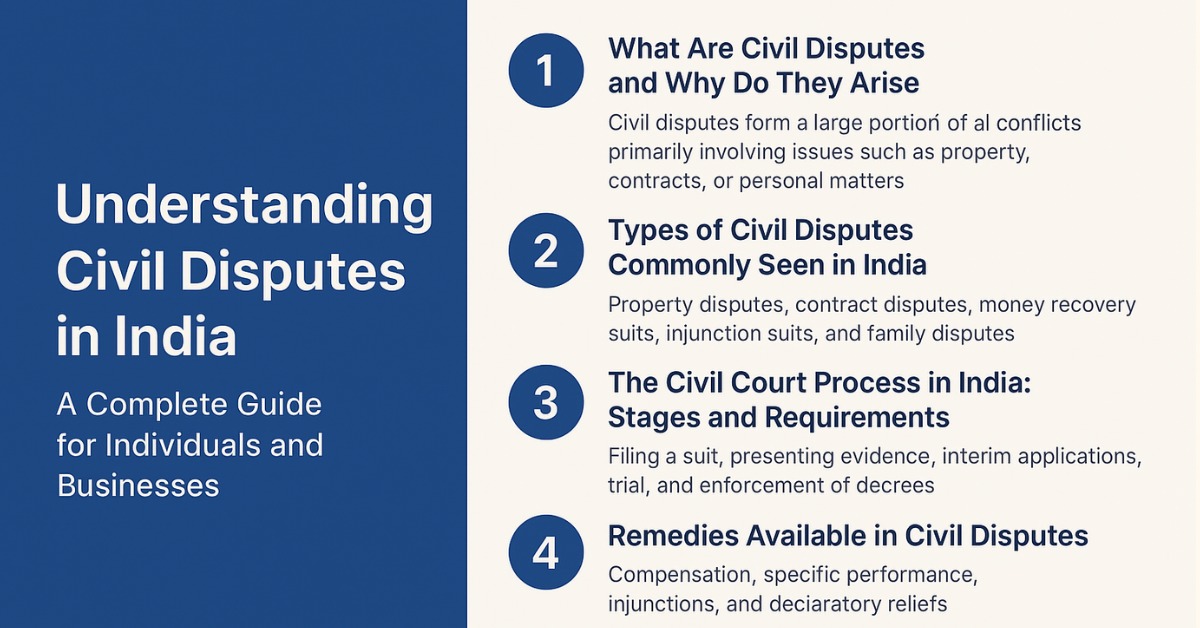
3. The Civil Court Process in India: Stages and Requirements
Understanding civil disputes in India also involves understanding how the civil court process works. Civil litigation follows a structured sequence of filings, responses, interim stages and final adjudication.
The process begins with filing a plaint, which is the written statement of claims. The plaint includes facts, cause of action, jurisdiction, reliefs sought and supporting documents. Courts determine jurisdiction based on territorial factors and pecuniary jurisdiction India, which relates to the monetary value of the claim.
After the plaint is admitted, the court issues summons to the defendant. The defendant must file a written statement responding to each allegation. If needed, the plaintiff may file a replication clarifying issues.
Interim applications may be filed for temporary injunctions, appointment of commissioners, preservation of property, restraint orders or urgent relief. Courts may grant temporary relief to prevent further damage until the final decision.
Once pleadings are complete, the court frames issues which represent the questions to be decided. Evidence is led by both sides using documents, witness statements and cross examination. This is followed by arguments where parties present their legal position.
Finally, the court pronounces a judgment and issues a decree which is enforceable. Execution proceedings may be used to enforce the decree through attachment of property, appointment of receivers or any mode permitted by law.
Throughout the civil litigation process, parties may pursue settlement or mediation. Civil dispute resolution India encourages mediation at multiple stages to reduce delays and encourage amicable outcomes.
4. Remedies Available in Civil Disputes
Civil remedies India provide multiple options depending on the nature of the dispute. Understanding civil disputes in India requires knowing which remedies are appropriate for each situation.
One common remedy is compensation or damages, where the court orders payment to the aggrieved party for financial loss caused by breach of rights or obligations. Damages may include actual loss, lost profits or compensation for inconvenience depending on circumstances.
Another important remedy is specific performance, where the court directs a party to perform its contractual obligation, often used in property or unique goods cases.
Injunctions play a major role in protecting civil rights. Temporary and permanent injunctions are used to prevent trespass, protect confidential information, restrain unlawful construction or stop misuse of property. Injunction suits India are common when delay could cause irreparable harm.
Declaratory reliefs are sought when parties need a formal declaration of rights, title or legal status, especially in property disputes India or succession cases.
Courts may also order restitution, partition, accounting, rectification, cancellation of documents or delivery of property depending on the facts.
In money related disputes, courts may issue decrees for recovery of money, interest, liquidated damages or refunds. For consumer disputes, compensation, replacement or service corrections may be granted.
Understanding these remedies helps parties choose correct legal strategies and obtain meaningful relief.
5. Practical Guidance for Individuals and Businesses
Understanding civil disputes in India is not limited to knowing laws and procedures. Practical preparation and documentation play a critical role in successful civil dispute resolution India.
Parties should maintain complete documentation relating to agreements, transactions, payments, communications and property. Courts rely heavily on written evidence. Poor record keeping often weakens otherwise strong claims.
Clear written contracts reduce the chance of conflict. Oral arrangements or informal commitments often lead to disputes due to ambiguity. Parties should record responsibilities, timelines, payments, termination rights and remedies in written agreements.
Before initiating litigation, parties should evaluate the strength of their case, availability of evidence, cost implications and timelines. In many situations, negotiation or mediation can produce quicker and cost effective outcomes compared to a full civil court process India.
Businesses must establish internal processes for contract management, timely invoicing, documentation of communications and legal compliance. A proper dispute resolution clause in contracts can streamline conflict management.
Individuals should seek legal advice when dealing with property transfers, loan agreements, family settlements or high value transactions. Early guidance prevents structural mistakes that escalate into litigation.
Understanding civil rights enforcement and the range of civil remedies India offers empowers parties to make informed decisions, protect their interests and reduce exposure to legal risk.
Conclusion
Understanding civil disputes in India is essential for anyone entering agreements, owning property, lending money, purchasing goods or dealing with service providers. Civil disputes arise from everyday interactions and require structured resolution through the civil litigation process. From property disputes India to contract disputes India, courts provide remedies such as compensation, specific performance, injunctions and declarations to protect private rights.
By maintaining proper records, understanding jurisdiction, following timelines and seeking professional guidance when needed, individuals and businesses can navigate disputes effectively and protect their legal interests. Civil law remains a vital pillar of India’s justice system, offering transparent and reliable mechanisms for resolving conflicts and enforcing rights.