
Understanding the Basics of the Contractual Disputes
Contracts control most aspects of personal and business life in India. Whether an individual buys a product, signs an employment letter, rents a property, or hires a service provider, a legally binding arrangement is created. Due to this, understanding the basics of Indian Contract Act 1872 and how contractual dispute issues are addressed is extremely important. This legislation provides the foundation for how agreements are made, how rights and duties are enforced, and what happens when promises are broken.
The Indian Contract Act basics include principles such as offer and acceptance, consideration in contract law, free consent, capacity to contract, and lawful object. These rules ensure that agreements are fair, transparent, and enforceable. The Act also defines remedies available in the event of breach of contract India, making it a comprehensive structure for resolving disputes.
This blog offers a detailed breakdown of the essentials of a valid contract, different types of contracts India recognises, rules for performance, consequences of breach, and the relevance of contract law in daily life.
1. Purpose, Scope, and Structure of the Indian Contract Act, 1872
The Indian Contract Act, 1872 was enacted to create uniformity and predictability in contractual relationships. It lays down the rights and obligations of parties entering agreements and ensures that transactions operate with fairness and good faith. It governs all agreements that create legal obligations, regardless of whether they are written, oral, or implied.
Understanding the basics of Indian Contract Act 1872 starts with recognising that it applies to:
- Business agreements
- Employment arrangements
- Consumer purchases
- Service engagements
- Rental and lease transactions
- Financial transactions
- Partnerships and collaborations
The law applies across India except in situations where a special statute replaces or overrides these general rules.
The Act is structured into two major parts:
- General principles applicable to all contracts
- Specific types of relationships such as indemnity, guarantee, bailment, pledge, and agency
This structure ensures that Indian Contract Act basics apply uniformly, while also addressing unique situations arising from specialised relationships.
The Act’s purpose is not only to define contract enforceability but to protect parties from exploitation, uncertainty, and unfair bargaining. It offers a predictable legal framework that supports economic growth, commerce, and stable business practices across the country.
2. Essentials of a Valid Contract under Indian Law
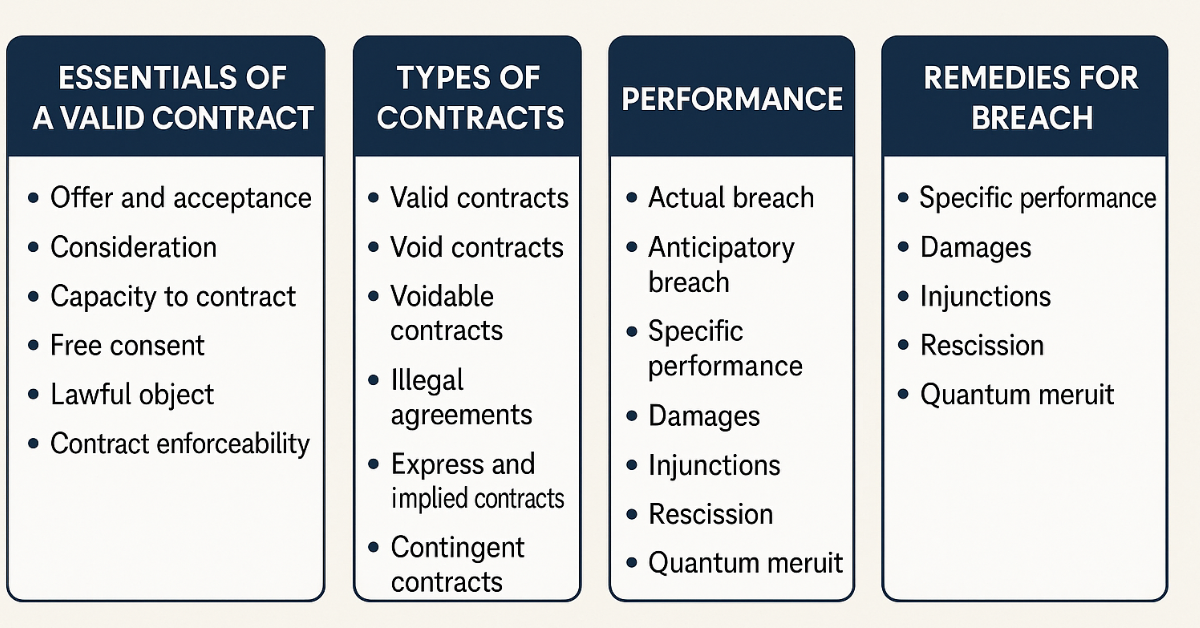
A major component of understanding the basics of Indian Contract Act 1872 is learning what makes an agreement enforceable. The essentials of a valid contract include several foundational elements.
a. Offer and acceptance:
The contract begins when one party makes a clear offer and the other communicates acceptance. Acceptance must be unconditional and must correspond exactly to the offer. Counter-offers or partial acceptance do not constitute valid acceptance.
b. Consideration in contract law:
Consideration refers to something of value exchanged between the parties. It can be money, goods, a service, an action, or a promise. Without lawful consideration, the agreement generally does not become binding.
c. Capacity to contract:
All parties must be legally competent. Minors cannot enter enforceable contracts, except for contracts for necessities. Persons of unsound mind or those legally disqualified by specific statutes also lack capacity.
d. Free consent:
Consent must be voluntary. If consent is obtained through coercion, undue influence, misrepresentation, fraud, or mistake, the contract becomes voidable. Free consent ensures fairness and protects parties from unfair pressure.
e. Lawful object and lawful consideration:
The objective of the agreement must be legal. Contracts involving illegal acts, fraudulent activity, or actions against morality or public policy are void.
f. Intention to create legal relations:
Parties must intend for the agreement to be enforceable. Social and domestic agreements often lack this intention, whereas commercial agreements usually carry such intention automatically.
g. Certainty and possibility of performance:
The contract must be clear and capable of being performed. Agreements that are vague, impossible, or involve uncertain terms are invalid.
Understanding these essentials of a valid contract gives individuals and businesses clarity on whether the agreements they enter are legally sound.
3. Contractual Dispute Implications and Types of Contracts in India
Another key part of understanding the basics of Indian Contract Act 1872 is recognising the different types of contracts India categorises based on enforceability, mode of formation, and performance.
a. Valid contracts:
These satisfy all essential elements and are enforceable in a court of law.
b. Void contracts:
These are agreements that cannot be enforced. They may be void from the beginning or become void due to subsequent impossibility or illegality.
c. Voidable contracts:
These remain valid unless the aggrieved party chooses to void them. Lack of free consent often makes a contract voidable.
d. Illegal agreements:
These are not only unenforceable but also criminally or civilly penalised. Examples include contracts to commit a crime or agreements that involve fraudulent intentions.
e. Express and implied contracts:
Express contracts involve written or spoken terms. Implied contracts arise from conduct or circumstances, such as using public utilities or availing common services.
f. Contingent contracts:
These depend on the occurrence or non-occurrence of an uncertain future event.
g. Quasi-contracts:
These are obligations imposed by law to prevent unjust enrichment, even though no actual contract exists.
Knowing the types of contracts India recognises allows parties to anticipate potential areas of contractual dispute, evaluate legal exposure, and strengthen enforceability. This understanding supports informed decision making, aligns commercial expectations, and ensures that parties can identify suitable remedies when obligations are not honoured. It also enables a structured approach to risk management throughout the contract lifecycle.
4. Performance, Disputes, and Legal Remedies Under the Act
Once a contract is formed, the next phase relates to performance. Parties must fulfil their obligations exactly as specified. When they do not, it leads to breach of contract India.
Types of Disputes include:
- Actual breach: occurring at the time performance is due
- Anticipatory breach: one party indicates beforehand that they will not perform
The Act provides several remedies for breach:
a. Damages:
Monetary compensation for financial loss. Courts assess direct loss, indirect loss, and consequential damages, depending on the situation.
b. Specific performance:
A court order requiring the defaulting party to perform the contract. This remedy is often used in property and unique goods contracts.
c. Injunctions:
Courts may restrain parties from acting against the terms of the contract.
d. Rescission:
The contract is cancelled, and parties are restored to their pre-contract positions.
e. Quantum meruit:
The aggrieved party is allowed payment for work already completed, even if the contract becomes void or is terminated prematurely.
These remedies ensure contract enforceability and help maintain fairness in commercial dealings.
5. Importance of the Act in Daily Life and Business Transactions
Understanding the basics of Indian Contract Act 1872 is essential for both individuals and businesses. It will not only help you to deal with contractual disputes but will also help you into avoiding getting into such disputes like it is said, precaution is better than cure.
In consumer transactions, every online purchase, service subscription, and warranty claim operates under contract law.
In property dealings, rental agreements, lease contracts, and even maintenance arrangements depend on contract enforceability.
In business, vendor agreements, franchise contracts, consultancy engagements, and partnership terms must meet essentials of a valid contract to avoid disputes.
Even negotiations and settlement agreements rely on Indian Contract Act basics to determine whether they are binding.
Understanding these principles ensures that parties enter agreements with clarity, manage expectations properly, and minimise legal risks.
Conclusion
Understanding the basics of Indian Contract Act 1872 allows individuals and organisations to enter agreements responsibly and confidently. By knowing the essentials of a valid contract, the types of contracts India recognises, and the remedies for breach of contract India, parties can protect their rights and avoid unnecessary disputes.
The Act continues to play a key role in ensuring fairness, accountability, and clarity in business, personal, and commercial relationships.